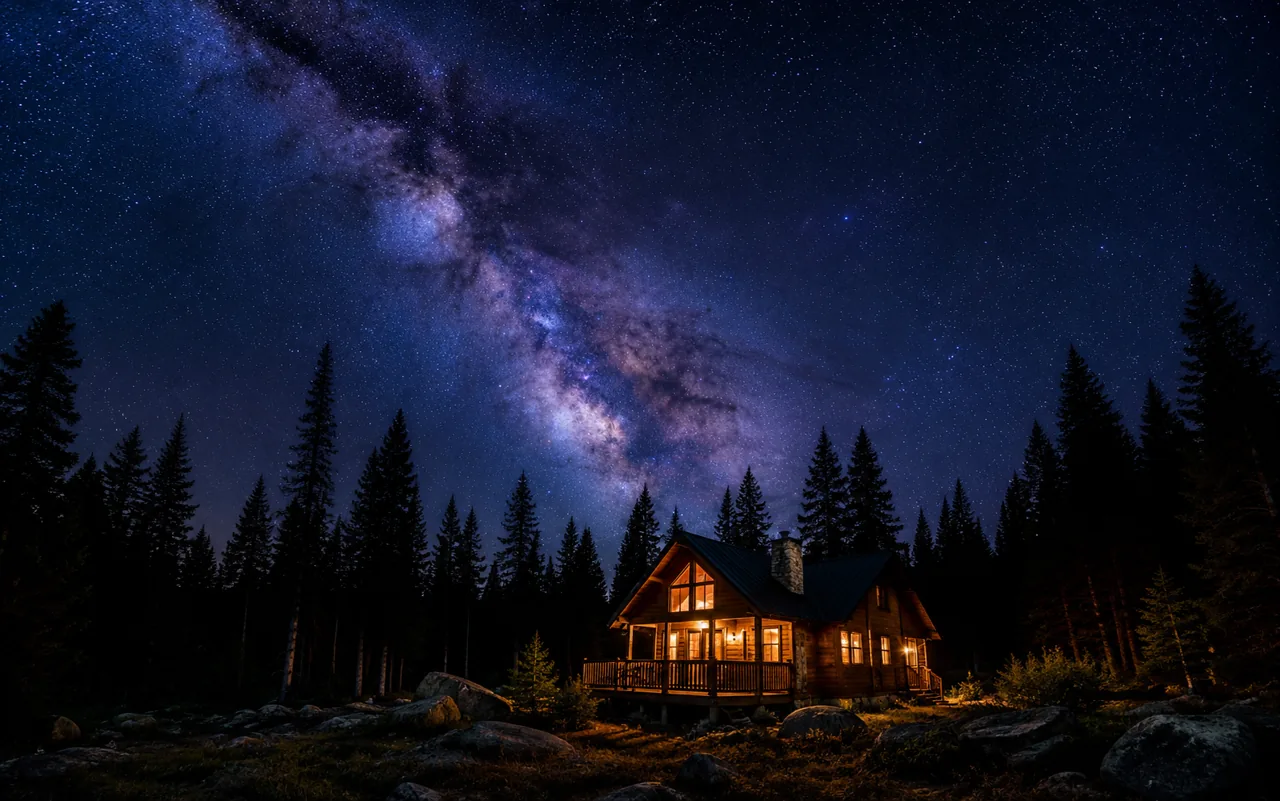
The first time most people see a genuinely dark night sky, they describe it as overwhelming. The Milky Way isn't a faint smudge — it's a bright, layered band stretching the whole length of the sky, with structure visible to the naked eye. There are so many stars that the familiar constellations get harder to find rather than easier. It's the kind of thing you assume the previous generations were exaggerating about, until you see it once and realise they were actually underselling it.
The reason most of us have never seen it is mundane. The spread of light pollution over the last century means that around eighty percent of people in North America live somewhere they can no longer see the Milky Way from their back garden. You don't have to travel far to find a sky that wasn't possible a generation ago — but you do have to travel deliberately. A well-chosen cabin in the right place gives you that sky every night of your stay, with no effort beyond walking outside after dinner.
What "dark sky" actually means
Astronomers measure night-sky quality on a scale called the Bortle scale, from 1 (truly pristine) to 9 (inner city). Most cabin country sits somewhere between 2 and 5. A Bortle 2 or 3 sky will show you the Milky Way with structure visible to the naked eye. A Bortle 4 will show you a hazier version. A Bortle 5 is what most people would call a "starry night" — pretty, but the Milky Way is barely visible. The difference between a Bortle 3 cabin and a Bortle 5 cabin, both of which look rural on a map, is enormous in practice.
The easiest way to check is the free Light Pollution Map, which colour-codes the entire world by night-sky brightness. A two-minute check before you book can be the difference between a cabin with a transcendent sky and a cabin where you can just about pick out Orion.
The cabins to look for
Beyond the map data, a few practical features make a cabin much better for stargazing. A genuinely open horizon — trees are beautiful but they hide half the sky, so a cabin near a meadow, a lake, or a clearing is far better than one deep in a forest. A porch or deck on the side facing the darkest direction (usually away from any nearby town). No exterior lights left on overnight, or at least lights you can turn off completely. Lights with motion sensors are the worst, because they switch on every time a deer wanders past and ruin your night vision for the next thirty minutes.
Some cabins explicitly market themselves as dark-sky destinations and include features like reclining loungers, blackout curtains so the cabin doesn't leak light, and even small telescopes for guest use. These are worth seeking out if stargazing is the point of your trip rather than a bonus.
The moon is the other half of the equation
Even the darkest cabin will give you a mediocre Milky Way view if you visit during a full moon — the moon itself washes out the sky almost as effectively as a small city. For serious stargazing, time your trip around the new moon, or visit during the few hours after the moon sets if you're staying during a half moon. A simple lunar calendar will tell you the moon phases for any week. Planning a stargazing-focused trip without checking the moon is the single most common mistake first-timers make.
The simplest setup that works
You don't need a telescope. The naked eye, given a properly dark sky and twenty minutes for your pupils to adjust, sees an astonishing amount. A pair of decent binoculars (8x42 is the standard recommendation) is the second-best investment, and a far better starting point than a cheap telescope. A folding chair you can recline in, so you're not craning your neck for an hour. A red-light head torch — red light preserves night vision, white light destroys it — so you can move around without resetting your eyes. That's the entire kit. Add a flask of something warm and you've got a perfect cabin evening.
Bring the kids out at the right time
For families, the trick is to time the stargazing for the first hour after astronomical dark, before the kids are too tired to enjoy it. In summer at higher latitudes this might be quite late, which is part of the appeal — staying up past bedtime is half of why kids remember the trip. Point out two or three specific things rather than trying to teach them every constellation: the Milky Way itself, the brightest planet on view that night, and one constellation they can find by themselves. They'll remember it for years.